Secondary Container Labels
sdsLite generates compliant secondary container labels on demand, each with a QR code.

How it works
Labels built from your SDSs
Find a product in sdsLite and print a label for it. The label is filled in from the product's current SDS, including the product identifier, hazard pictograms, signal word and precautionary statements [confirm which elements appear]. Each label also carries a QR code that opens the product's SDS with no login required.
Because labels draw on the same data as your SDS library, they stay consistent with it. When a vendor issues a revised SDS, the next label you print reflects the change, and the QR code on labels already in use opens the current sheet.

Regulatory Compliance
OSHA HazCom
Under 29 CFR 1910.1200(f)(6), workplace containers must carry either the same label information as the shipped container or the product identifier with enough words, pictures or symbols to convey the general hazards. The only exception covers a portable container meant solely for the immediate use of the employee who filled it. A spray bottle left on a cart for the next shift no longer qualifies.
sdsLite labels include all the essential elements to satisfy regulatory compliance. The QR code adds a direct route to the full SDS, which also supports your employee training on how to read labels and find more information.

WHMIS
When a hazardous product is transferred from its original container, WHMIS generally requires a workplace label with the product identifier, safe handling information and a reference to the SDS where one is available. Your provincial or territorial regulations set the exact requirements, including any exemptions for products used immediately by the worker who decanted them.
sdsLite labels cover each required element and go a step further, since the QR code takes workers straight to the SDS itself.

COSHH
COSHH requires employers to give workers suitable information about the hazardous substances they work with, including access to the relevant safety data sheets (Regulation 12). Separately, the Health and Safety (Safety Signs and Signals) Regulations 1996 require containers of dangerous substances used at work to be marked with the relevant hazard pictograms.
sdsLite labels carry the GHS pictograms for each product, and the QR code gives anyone handling the container direct access to its SDS. That covers decanted products that would otherwise be identified by a handwritten marker or not at all.

ISO 45001
ISO 45001 asks organizations to put operational controls in place for identified hazards (clause 8.1) and to communicate relevant OH&S information to workers, contractors and visitors (clause 7.4).
A consistent labelling process is one of the simplest controls available for chemical transfers. Every label comes from the same approved SDS data, so the information on a spray bottle in one department matches the information in another. The QR code extends that communication to anyone who picks up the container, whether or not they have a login.

Implementation
How it works in your facility
A printer is all you need to start. Most sites keep a supply of pre-printed labels for regularly decanted products at the transfer point, such as the chemical storage room or the dispensing station, and print one-off labels as new products are decanted.
Secondary labels pair well with Point of Use Libraries. The library's shelf label shows workers which products belong at a station, and the container labels identify each one once it has been decanted.

See It in Action
Skip the small talk. Book a demo of the system you'll actually use, every day.
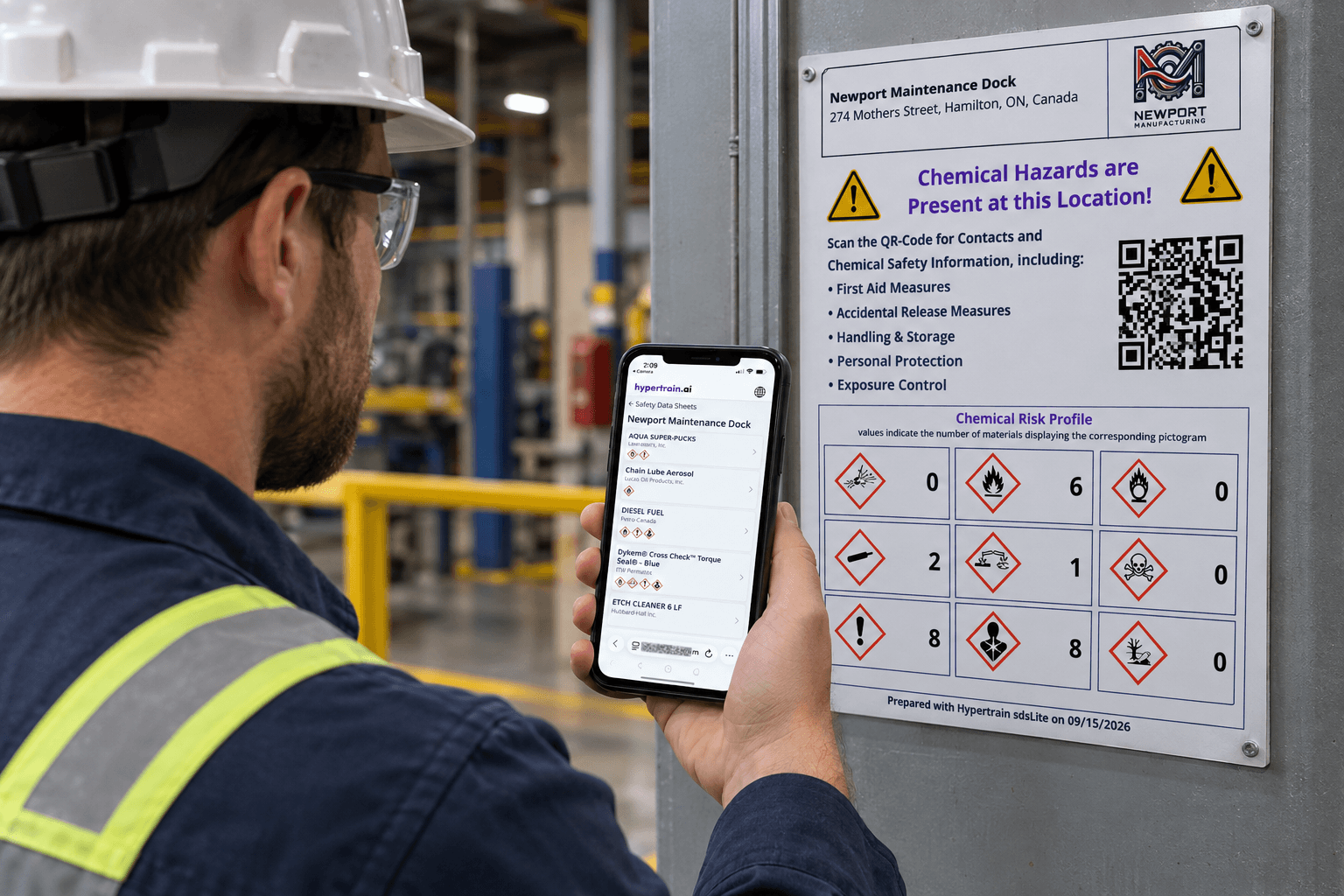
Everything you need for chemical safety, in one platform.

Automated Updates
We monitor vendor updates and regulator sources so your SDSs are always current.
No-Login Access
QR codes and simple URLs give your team instant access, where they need it, without a login.
Safety Signage
Download and display chemical safety signage throughout your facility.
Secondary Labels
Generate OSHA compliant secondary labels for containers and smaller storage areas.
Point of Use Libraries
Generate Point of Use SDS libraries to give your employees contextual knowledge of their job, cabinet or workstation.
$1,500/year
Single-site license
|
Up to 200 SDSs
Multi-site discounts available